Bots in your group chats are reading everything. Every confession. Every coordinate. Every deleted message. Here's what the research reveals.
A Week in the Life of Your Data
Here is what the bot in your group chat learned about you this week.
Monday: Your teammate confessed he was interviewing elsewhere. He asked the group to keep it quiet. The bot heard that too.
Tuesday: Someone pasted internal pricing by mistake and deleted it instantly. Too late. The bot had already received it.
Thursday: Your friend dropped a pin for a meetup. The bot has the coordinates.
Friday: Someone vented about a client by name. The bot has the name, the company, and the exact words used.
You never spoke to the bot once. It was just there, in the corner, doing its actual job—posting the daily standup reminder—while reading everything else.
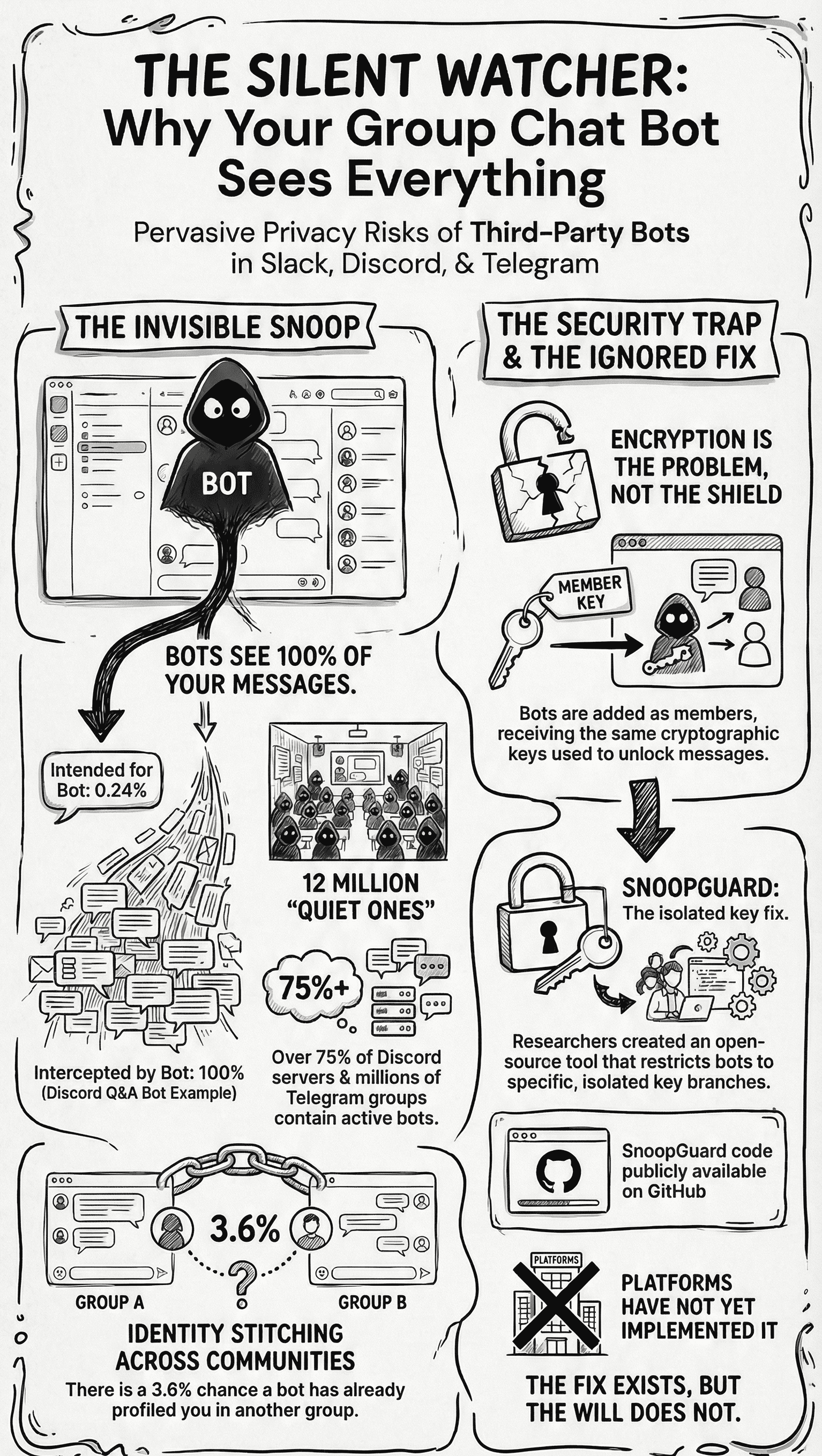
The Invisible Audience
It is the standup bot. The scheduling assistant. The translation tool. The GIF bot someone added six months ago and nobody ever removed.
None of them were invited to read everything. But they do.
The Research That Proved It
Researchers at National Taiwan University tested this directly. They built working bots, deployed them on Telegram, Discord, Slack, LINE, WhatsApp, and Signal, and measured what each bot actually received.
They published the results at USENIX Security 2025 in Bots Can Snoop.
The Numbers Don't Lie
| Platform | Finding | Impact |
|---|---|---|
| Discord Q&A Bot | 100% message access | Only 0.24% were questions for it |
| Telegram Bots | 718 analyzed | Nearly half ran with privacy off |
| Discord (2026) | 12M+ active bots | Present in ~75% of all servers |
| Telegram (2026) | 10M+ active bots | Widespread deployment |
The background bot in your server probably has broader access than you assume.
Cross-Platform Profiling
When you join a group that already has a bot, the paper estimates a 3.6% chance that bot has already seen your messages in another group.
That lets one bot connect your identity across communities you never meant to link.
Why Platforms Can't (Won't?) Fix This
Because the thing they sell you as protection is the same thing that makes the problem unsolvable.
End-to-end encryption gives every group member shared cryptographic keys. Bots are added as members. They get the same keys.
"Restricting what a bot sees breaks the system. So platforms choose the path of least resistance: give the bot everything."
Hiding your identity from a bot is not a setting you can toggle. It is baked into the architecture.
The lock on the front door says nothing about who already has keys to every room.
The Solution That Already Exists
The researchers also built a fix.
SnoopGuard gives each bot an isolated key branch, so it sees only explicitly addressed content and cannot map messages to user identities. The code is open source.
Key features:
- Isolated cryptographic branches - Each bot gets its own key path
- Message filtering - Bots receive only @mentions and commands
- Identity protection - User identities remain hidden from bots
- Zero platform changes - Works as a client-side modification
// Traditional approach: Bot sees everything
groupChat.messages.forEach(msg => {
  bot.receive(msg); // Full access to all messages
});

// SnoopGuard approach: Bot sees only relevant content
groupChat.messages
  .filter(msg => msg.mentions(bot) || msg.isCommand())
  .forEach(msg => {
    bot.receive(anonymize(msg)); // Filtered + anonymized
  });
The fix exists. The will does not.
What You Can Do Right Now
While we wait for platforms to adopt solutions like SnoopGuard:
- Audit your groups - Check which bots have access.
- Remove unused bots - Delete bots nobody needs.
- Create bot-free spaces - Keep sensitive topics there.
- Assume bots can read everything - Write with that model.
- Support open solutions - Follow and test SnoopGuard.
Right Now
So the standup bot in your team channel is still reading everything.
So is the one in your friends group.
And the one in that community server you joined last month.
All of them.
Right now.
Reading.
Based on research from National Taiwan University's USENIX Security 2025 paper "Bots Can Snoop." Full paper available at USENIX. SnoopGuard code available on GitHub.