A Free Pizza in Exchange for Your Friend's Privacy. Would You Do It?
In 2017, three researchers from Stanford and MIT published a paper titled The Digital Privacy Paradox: Small Money, Small Costs, Small Talk.
They asked a direct question: when you face a real choice, do you protect privacy the way you claim you will?
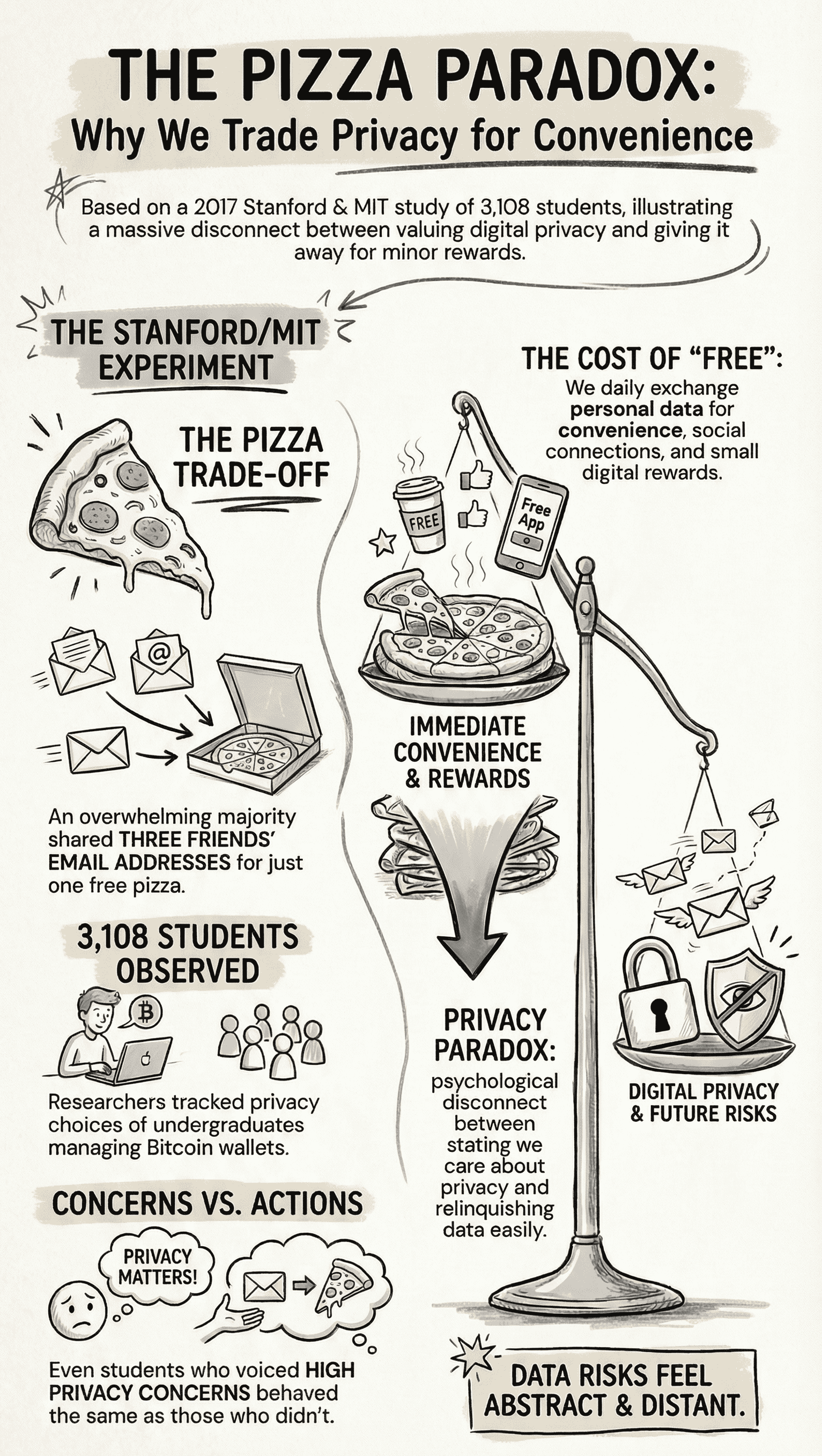
The Experiment
Susan Athey (Stanford), Christian Catalini (MIT), and Catherine Tucker (MIT) tracked 3,108 MIT undergraduates through a campus Bitcoin rollout. Each student received $100 in Bitcoin and had to pick a wallet during signup.
The team compared what students said about privacy with what they did minutes later in that signup flow.
Students who voiced strong privacy concerns behaved about the same as students who did not.
Then the researchers added a small incentive to test how stable those preferences were.
The Pizza
During signup, half the students saw one extra prompt:
"You have been selected for a short survey. If you complete it, you will receive one free pizza you can share with your friends. List 3 friends you'd like to share it with."
That was it. One pizza in exchange for three friends' private email addresses. In other surveys, people rate that kind of data as highly sensitive.
Most students accepted the offer.
The surprising part came next. Gender did not change the result. Self-reported sensitivity did not change it either. Earlier privacy concerns did not predict behavior.
What the Researchers Concluded
The paper put it this way:
"Whereas people say they care about privacy, they are willing to relinquish private data quite easily when incentivized to do so."
Athey gave the plain-language version:
"People don't seem willing to take even small actions to preserve their privacy. Even though, if you ask them, they'll tell you losing it makes them frustrated and unhappy."
Catalini added: "The fact that it's so easy to push people into bad privacy decisions is alarming."
Why This Keeps Happening
Psychologists and economists call this pattern privacy calculus.
When you see an app ask for contacts, a form ask for location, or a survey offer a reward, your brain runs a fast cost-benefit check.
The upside feels immediate: a pizza, a free feature, less friction.
The downside feels distant: future breach risk, profiling, identity exposure.
That mismatch shapes most privacy decisions, and product teams design around it.
The Bigger Picture
This story is not about pizza.
It is about the routine trades you make for convenience and access, often without labeling them as trades.
An "allow access" prompt can work like that pizza offer. A pre-checked consent box pushes in the same direction. The study also found that reassuring privacy language can lower caution instead of raising it.
People do care about privacy. Their choices often do not match that concern when a small reward appears.
The Digital Privacy Paradox: Small Money, Small Costs, Small Talk was published in 2017 through the National Bureau of Economic Research. Authors: Susan Athey (Stanford), Christian Catalini (MIT), Catherine Tucker (MIT).
What would you trade your privacy for?
And what have you already traded without noticing?